
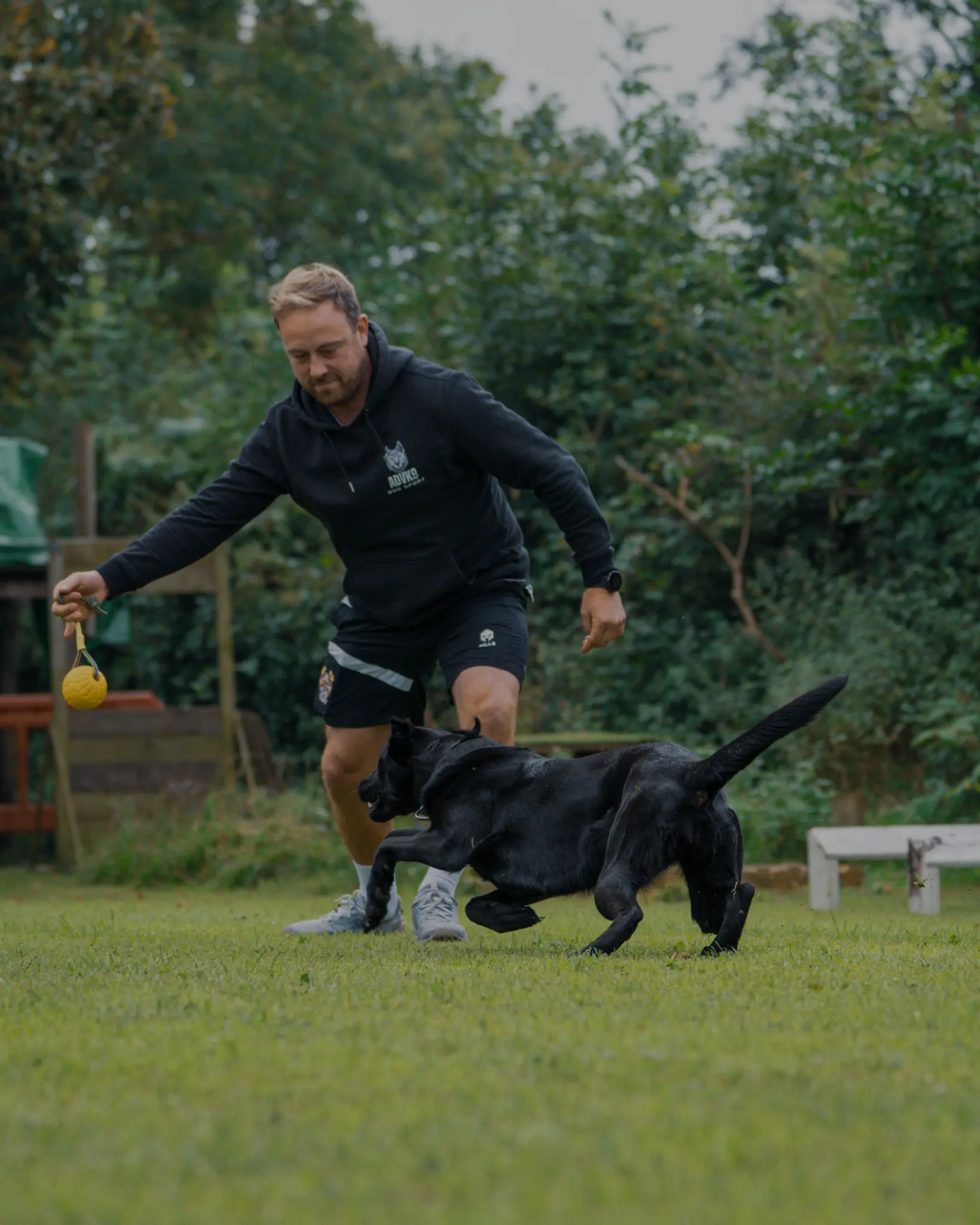
Working-breed puppy training starts with everyday skills: choosing to engage with you, accepting gentle handling, returning when called and switching off afterwards. My recommendation is to build those skills in the calm places where a puppy can succeed, then make one small change at a time as life becomes busier. The aim is a dog that can enjoy activity and also settle, rather than a puppy kept occupied all day.
Choose the foundations you will use every day
Before adding lots of cues, decide what will matter in your home: a puppy who can come away from a doorway, wear a harness, let you check a paw, return to you, release a toy and rest while ordinary life goes on. These are small pieces, but they make later lead work, walks and adolescence easier to organise.
Keep the first versions simple. A puppy may understand a cue in the kitchen and need the same cue rebuilt in the garden or on a quiet walk. That is normal learning in a new setting, not a reason to add pressure. Change one variable at a time: location, distance, movement or distraction.
Let new experiences stay gradual and optional
Early exposure is about giving a puppy calm, positive information about ordinary life, not completing a checklist of greetings. From a suitable distance, a puppy can watch a person, dog, bicycle or new place, take food or play with a toy, and then leave before the experience becomes too much. A calm observation can be more useful than a close interaction.
Watch the puppy rather than the plan. If they move away, freeze, become overly excited or look worried, increase distance or finish the outing. Do not force a greeting. Speak to your vet about when your puppy can safely go on public ground, taking their individual vaccination advice into account.
Build safe toy engagement without pressure
A toy can become a useful reward for a puppy who enjoys chasing, carrying or tugging. It is an invitation, not a test. I would rather see a small, eager game that finishes well than repeated attempts to make a tired, worried or uninterested puppy play. Drive is not something to force into a puppy.
- Start with the right setup. Choose a toy that is an appropriate size and in good condition. Introduce new toys under supervision, clear the immediate floor space and keep fingers out of the line of the puppy’s mouth.
- Make the toy easy to notice. Hold it low and move it gently away from the puppy. Let the puppy choose to follow and take it; do not put it in their mouth or pull them into a game.
- Keep tug on the ground. Let the puppy keep all four feet on the floor. Never lift, swing or dangle a puppy from a tug. Stop while the game is still comfortable, and take a break if the puppy becomes frantic, mouthy, vocal or starts missing the toy.
- Let food remain available. If the puppy would rather take a small food reward than engage with a toy, use food. You can offer the toy again on a different day or in a quieter place; there is no need to manufacture interest.
If a puppy redirects onto hands, clothing or another person, calmly end access to the toy and create space without a confrontation. Repeated redirected biting, guarding of toys or food, or any bite history needs veterinary and suitably qualified behaviour advice rather than a tougher game.
Use food and toys as complementary rewards
Food and toys do different jobs for different dogs. Food is often practical for a quiet check of the harness, a pause on a bed or a precise first repetition. A toy can be a lively reward for returning, moving with you or taking part in a short game. The useful reward is the one this puppy wants in this place at this moment.
Keep a simple reward inventory. Notice whether your puppy takes food readily, re-engages after a toy game, wants praise or prefers access to sniffing. In a more distracting setting, an ordinary biscuit may no longer compete with the environment; move back to an easier version or use a reward the puppy values more. When food is part of training, account for it within the puppy’s overall daily food allowance.
For a toy-loving puppy, food can also help with calm transitions. For a food-loving puppy, a toy can remain a low-pressure option for play. Neither reward has to replace the other.
Teach an out cue, a release and recall as separate skills
Teach a toy release before you need to retrieve a toy quickly. With a calm puppy holding the toy, place a food reward near their nose. As the mouth opens, say your chosen cue such as “out”, give the food and then either restart the game or put the toy away. Repeating that sequence makes letting go predictable rather than a loss. As the puppy understands it, vary whether the next reward is food, a restart of the game or a calm finish. For a fuller progression, see our guide to teaching an out with tug as a reward.
A release word such as “free” has a different meaning: the exercise has finished and the puppy may move away, sniff or return to an appropriate activity. Keeping the two cues distinct helps the puppy understand whether you are asking them to let go of an item or simply ending a moment of training.
Start recall in a quiet, safe space. Get the puppy’s attention, use one consistent recall cue, move away a little and reward when they reach you. Do not keep repeating the cue when the puppy is unlikely to respond. Teach a gentle collar or harness touch separately at home, so coming close does not always predict being held or having the lead attached.
When you add distance or distraction, use a well-fitted harness and an inspected long line where it is appropriate. Keep the line clear of hands and legs, manage the slack and distance, and avoid a puppy running at full speed into the end of it. Gloves can be useful. A long line manages risk while you train; it does not create an emergency recall. Build any emergency cue separately in low-risk practice, rather than testing it in a real emergency. Our long-line and emergency-recall guide explains that distinction in more detail.
Protect the foundation through adolescence. A puppy who returned readily at home may need the easier stages repeated when the outside world becomes more compelling. Read how to rebuild recall for an adolescent working dog before treating a wobble as a reason to call more often or give more freedom than the dog can handle.
Make rest and handling normal parts of the day
Rest is a skill worth protecting. Give the puppy a predictable, low-key place to settle and allow quiet time after activity. Reward calm behaviour without turning rest into another exciting lesson. An alert puppy does not always need another game, visitor or walk; sometimes the helpful choice is to reduce the household action and let them decompress.
Handling works best as small, voluntary repetitions. Begin with a touch where the puppy already feels comfortable, remove your hand, then give a food reward. Build gradually towards the collar, harness, paws, ears and grooming equipment. Use the same calm cue before you touch the puppy if that helps them know what is coming.
Watch the response. Moving away, stiffening, freezing, repeated lip-licking or attempts to escape mean the step is too difficult. Stop, give the puppy a break and return to an easier stage later. Sudden sensitivity, suspected pain, marked fear or aggression during handling warrants a veterinary check and individual behaviour support.
Common mistakes that weaken puppy foundations
- Using the toy when the puppy is already over-aroused. A game that becomes wild or inaccurate is a cue to pause, not a reason to pull harder or keep the puppy going.
- Making every recall end the fun. In safe practice, occasionally reward the return and release the puppy back to suitable sniffing or play. This helps preserve the value of coming close.
- Calling from situations the puppy cannot yet leave. Prevent rehearsals of ignoring the cue by getting closer, reducing distraction or using suitable line management.
- Handling through discomfort. Forcing a puppy to endure a paw check or harness fitting can make the next attempt harder. Break the task down and reward the easy pieces.
- Filling every quiet moment. Activity, exploration and training all have a place, but a home routine also needs genuine downtime.
When to get individual help
These foundations are for a puppy who can take part safely. Seek veterinary advice for suspected pain or a sudden behaviour change. Severe fear, repeated redirected biting, resource guarding, human-directed aggression, separation distress or repetitive pacing and shadow chasing deserve support from a suitably qualified behaviour professional. A crate, more exercise or a stronger response is not a treatment for panic or distress.
Working-breed puppy training questions
Does every working-breed puppy need to be rewarded with a tug?
No. Some puppies enjoy tug early, some prefer food, and some need time before a toy has value. Offer a safe toy without pressure and use the reward the individual puppy is willing to work for. Food and toys can sit alongside each other rather than competing for one fixed role.
How do I teach my puppy to release a toy?
Begin with a calm, low-pressure game. Present food near the puppy’s nose, say the release cue as they let go, reward, then either restart the game or finish quietly. Avoid force or a struggle over the toy. If the puppy guards, redirects or becomes distressed, pause the exercise and seek appropriate help.
When is my puppy ready to be off lead?
There is no calendar answer. Readiness depends on the individual dog, the environment and the level of distraction. Build recall in enclosed, low-risk places first. In new or more distracting environments, a well-fitted harness and suitable long line can provide a safety margin. Do not use early recall practice around traffic, livestock or wildlife.
How much training and exercise should a working-breed puppy have?
There is no single rule based on breed label or age alone. Consider growth, health, temperament and what the puppy can recover from calmly. Balance safe exploration and short, successful learning with rest. Ask a vet about health or developmental concerns, especially if you are unsure about physical activity.